
Manufacturing Execution System (MES)
MES, is a comprehensive, dynamic software system that monitors, tracks, documents, and controls the process of manufacturing goods from raw materials to finished products. Manufacturing Execution System is a shop floor execution software that monitors and analyzes machines to ensure quality and efficiency are implemented in the manufacturing process. The main purpose of an MES is to solidify digital manufacturing and improve production efficiency.
MES implementation can integrate and connect with multiple sites, resulting in a transparent, controlled, and optimized environment for manufacturing.
- Improved quality control: As quality control information is transmitted in real time, companies with an MES can immediately halt production as soon as issues are identified. This reduces waste, scrap, overages, and re-work.
- Increased uptime: An MES generates realistic production schedules by balancing personnel, material, and equipment resources. It integrates scheduling and maintenance to maximize product flow and asset utilization – increasing uptime and improving overall equipment effectiveness (OEE).
- Reduced inventory: A manufacturing execution system updates inventory records with new production, scrap, and non-conforming material so that your purchasing, shipping, and scheduling departments know exactly what material is on hand at all times. This reduces just-in-case inventory and work-in-progress (WIP) inventory – saving money on manufacturing, transportation, storage, and inventory monitoring.
- Paperless shop floor: Eliminating paperwork means there is less chance for human error. It also means that the data recorded from the shop floor is immediately available to decision-makers across all integrated systems, to inform real-time decision-making.
- Improved product tracking and genealogy: An MES follows the entire production cycle from beginning to end, grouping final parts or batches with the corresponding manufacturing data. This data allows for improved regulatory compliance for manufacturers that must conform to government or industry regulations.
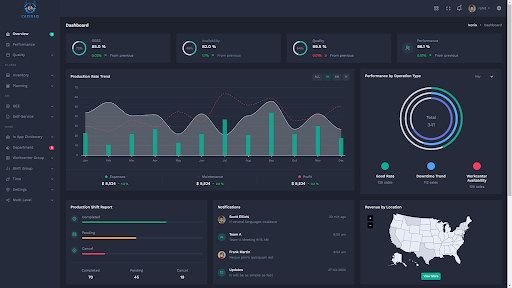
Features
Analytics
- Feeds - Production updates, notifications, alerts
- Global OEE - Productivity, Availability, Quality, OEE
- KPIS - Total Finished Products, Working, Produced Waste, Stopped
- Other: Ongoing production orders, Finished Production Orders
- Charts
- (Type) Productivity, Waste, Quantity, Time, OEE, Downtime
- Date Range
- Production Order
- Section
- Worker
- Machine
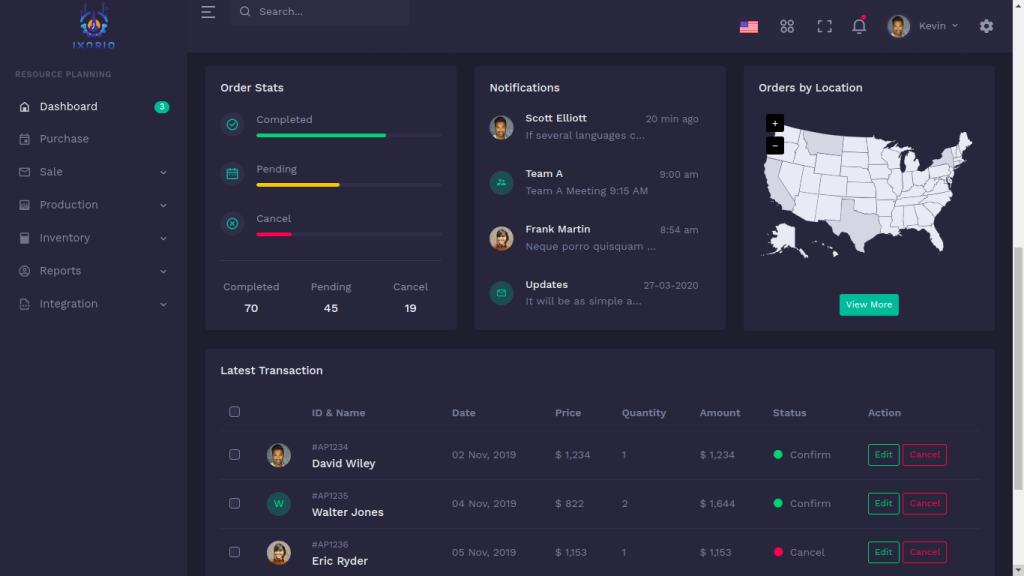
Manufacturing Resource Planning (MRP)
MRP is a system designed to plan manufacturing production. It identifies necessary materials, estimates quantities, determines when materials will be required to meet the production schedule, and manages delivery timing – with the goal of meeting demands and improving overall productivity.
Material planning can be simple and straightforward when volumes are low, the number of products is limited, and each product has only a few components. Sophisticated calculations are required for complex products and larger production volumes. The ability to forecast and plan for materials and components is critical for effective production and finished goods inventory management. This planned production is a necessary foundation for the planning and scheduling of equipment and skilled personnel. Inventory is typically a significant cost of doing business and one of the most important factors in manufacturer profitability. It is impossible to effectively manage inventory without material requirements planning in order to have just the right amount of the right items at the right time.
Catalog Management & e-Commerce
- Support unlimited stores, catalogs, categories, and products
- Handles a range of products (physical, digital, downloadable products, variant, configurable)
- Gift Certificates and gift cards
- Price rules for customer or group-specific pricing
- Online store promotion engine
- Integration with major payment gateway providers
- Fully integrated online and Point of Sales (POS) stores out-of-the-box
- Keyword search capability in all the
applications using hibernate search
Manufacturing
- Bill of Materials
- Job shop, Manufacturing
- Routings and Tasks
- Production Planning and
- MRP
- Production and Job Costing
- Equipment Billing
- Raw Material Procurement
- Manufacturing Reporting
Inventory Management
- Manage and setup single, multiple warehouses
- Inventory Locations
- Serialized on non serialized Inventory
- Lot Management
- Shipment Integration
- Picklist and Package Management
- Receiving
- Returns
Product lifecycle management
Product lifecycle management (PLM) is a method for controlling the complicated product creation process from the stages of inspiration, designing, production, and disposal. In order to properly manage the complete lifecycle of a product, it is a software solution that combines data, workflows, business systems, and people in a value chain.
- Improvements to development, engineering efficiency, and effectiveness Results from the Industry Week survey found that silos are the biggest challenge to engineering team performance. PLM enables the bi-directional flow of real-time data to support better knowledge-sharing and collaboration.
- Elimination of errors during the engineering release process It’s far simpler – and cheaper – to rectify product issues that are identified earlier on. PLM helps to reduce cost and offers the additional environmental benefit of reducing manufacturing waste.
- Reduced time to market Offering a single source of truth with up-to-date information at every phase of the product lifecycle, PLM empowers project managers to control overlapping timelines and get products to market faster.
- Improved project delivery A cross-enterprise, digital PLM solution supports advanced workflow management. In this use case, PLM allows a team to precisely calculate product costs and more effectively manage the handover to manufacturing new designs.
- Higher quality designs PLM offers designers and engineers a deeper level of insight into product requirements. Ingesting data from many different internal and external sources, a PLM system with integrated machine learning can turn performance data and customer feedback into new feature suggestions.
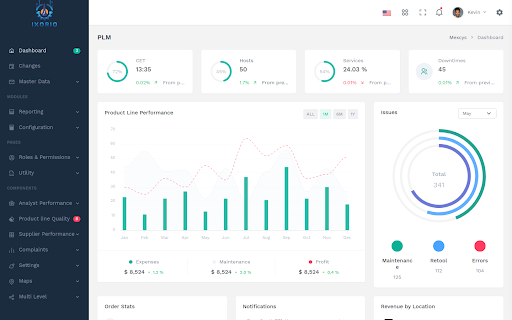
Project Lifecycle Management (PLM)
- Exponential growth in customer-driven product configurations requires manufacturers to find more flexible ways of production. Combining that with supply chain interruptions, evolving safety regulations, and time to market pressures and the challenges can be daunting.
- PLM provides the tools and methodologies for today’s dynamic plant-specific manufacturing environments, bringing together the shop floor with engineering, suppliers, logistics, and quality for a more connected and agile enterprise.
- Ixorio’s PLM monitors every phase of the manufacturing product’s lifecycle from early planning to manufacturing and allocation to customers.
- Bill of Materials
- Product Data Management
- Quote Process Management
- Collaboration and Reporting
- Workflow and Change Management
- Computer Aided Design (CAD) Tools
- Simulation